Animal Control
A Dog's JourneyAnimal Control appears as an authority involved in taking and temporarily holding Molly after police take CJ into custody. The agency has little direct presence in the story: its role is conveyed through the officers’ explanation, the arrival of a truck carrying a cage, and Molly’s experience of separation. That limited portrayal gives the institution a specific, consequential function without establishing its broader policies or operations.
Role and Representation
Animal Control enters the story as part of the response to CJ’s arrest. When CJ asks what will happen to Molly, an officer says Animal Control will be called and assures her that Molly will be held until CJ can pick her up. The reassurance frames the intervention as temporary, with the prospect of reunion built into the explanation. Yet for Molly, who understands the scene through her attachment to CJ rather than its institutional rationale, the promise cannot make the separation feel safe or comprehensible.
The agency is not given a representative character who explains its procedures, and the narrative does not describe its internal structure. Instead, Animal Control is legible through the actions and words surrounding its involvement: it is summoned, a truck with a cage arrives, and Molly is taken away. The narrowness of that depiction matters. The institution is present as a real force in the lives of the people and animals involved, but the scene remains close to the dog’s immediate experience rather than shifting into an administrative account.
Intake, Holding, and Reunion
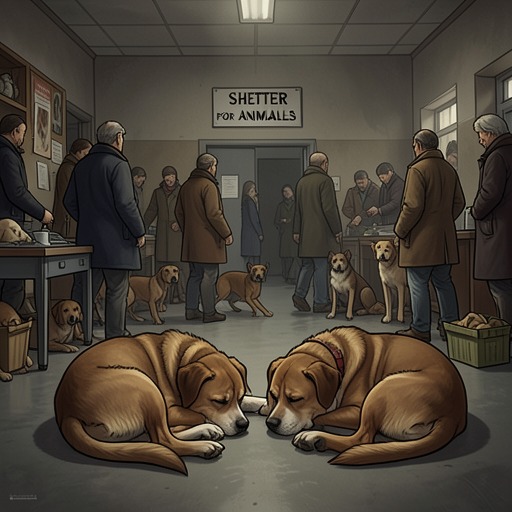
The story also presents Molly in a shelter setting after Gloria brings her there, describing her as a dog found abandoned in the streets and asking whether the location accepts lost dogs. This is Gloria’s account to the woman at the open door; the scene does not establish that the shelter is operated by Animal Control. Keeping the distinction clear, the episode nevertheless places Molly within a wider system of intake and confinement that provides context for what follows: a dog may be brought in by a person who claims to have found her, and a dog in a cage depends on someone else to secure her release.
At the shelter, Molly is returned to her cage after a man recognizes that she is chipped. Later, he comes back, addresses her by name, and leads her out because someone has come to see her. CJ’s arrival turns the institutional process into a reunion: Molly recognizes her scent, rushes to her, and receives her embrace. The scene gives the holding environment two sharply contrasting meanings. It is a place where Molly waits in confinement, but also the setting in which CJ finds her and restores their bond.
The later call to Animal Control repeats the danger of separation in a different circumstance. Here the arrival is marked by a truck with a cage on its back. Molly shrinks toward the ground when a man gets out carrying a pole with a loop, but CJ calls her to come over. She kneels, holds Molly’s head, and promises to collect her after a few days. Molly obeys, even though her final look toward CJ conveys that she does not understand why she must go. The officer’s assurance of future pickup and CJ’s promise offer complementary forms of reassurance, while neither changes the immediate fact that Molly is being taken from her.
Narrative Significance
The scenes distinguish the humane intention expressed by the people in the process from the animal’s experience of its consequences. The officer tells CJ that nothing will happen to Molly and that she can retrieve her; CJ speaks gently, holds Molly’s head, and leads her to the truck herself. Those gestures make the separation less abrupt than forcible handling might have been, but they cannot make it voluntary from Molly’s perspective. The contrast arises from the limits of what reassurance can communicate across that difference in understanding.
Animal Control therefore functions in the narrative less as a developed organization than as the point where personal crisis meets formal custody. Its call follows CJ’s detention; the truck and cage make the transfer concrete; the stated plan to hold Molly preserves the possibility of reunion. The episode gives that institutional promise emotional weight by showing what it costs in the moment: CJ has to entrust Molly to strangers, and Molly has to leave the person she has chosen to follow. The agency’s significance lies in this precise intersection of protection, confinement, and separation, not in any policy or procedure the story does not disclose.